Dentistry is full of moving parts. The schedule is tight. The phone won’t stop. Patients arrive early, late, anxious, and excited. Insurance rules change. Staffing is never perfectly stable. And on top of it all, clinicians are expected to document thoroughly, consistently, and fast.
For years, dental teams have relied on technology to bring order to that complexity—booking, charting, billing, treatment plans, recalls, reporting. But anyone who has worked in a practice knows a hard truth: not all “innovation” makes the day easier. Some tools add clicks. Some add friction. Some promise transformation and quietly deliver busy work.
That’s why ClearDent’s approach to AI has been deliberate.
Not because we’re hesitant about the potential. But because we’re serious about the responsibility.
AI is showing up everywhere in software right now. Some of it is genuinely helpful. Some of it is marketing hype. And some of it introduces new risks—especially in healthcare environments where trust, privacy, and accuracy aren’t optional.
So we started with a simple question:
Where can AI genuinely reduce burden in the practice day—without introducing new problems dressed up as solutions?
Before we jump in, let’s take a moment to understand the basics: where modern AI came from, and the main types of AI models you’ll see in dentistry.
A Quick AI history (in plain English)
AI has gone through a few “waves,” and each one explains why AI feels so present in healthcare and dentistry today:
Rules-based AI: early systems used hand-built rules (“if X then Y”). Helpful in narrow cases, but difficult to maintain.
Machine learning: models learn patterns from real-world data instead of relying only on hand-coded rules.
Deep learning: neural networks dramatically improved performance on complex pattern problems like images and speech.
Modern generative AI: systems that can write, summarize, and converse—useful for drafting and support, but requiring careful oversight in healthcare.
In other words: AI shifted from “clever demos” to “practical tools”—especially where there’s high volume, repeatable work, and meaningful data.
Types of AI models in the market today (and where they fit in dentistry)
Below are the most common AI model categories you’ll hear about. Each section includes what it is, what it’s good at, and how it can be applied in a dental practice.
1) Machine Learning (ML) model
Definition: Machine learning uses historical data to detect patterns and make predictions or classifications—often using structured data like dates, codes, payments, and appointment types.
Where ML applies in dentistry:
Insurance and billing workflows (e.g., identifying expected patient portions or adjustment patterns)
Why it matters: ML is strongest when the task is repeatable, data-driven, and measurable—exactly the reality of many administrative workflows.
2) Natural Language Processing (NLP) model
Definition: NLP helps computers understand and work with human language—reading, classifying, extracting meaning, and answering questions.
Where NLP applies in dentistry:
“How do I…?” in-software guidance and support
Intake and triage workflows (organizing patient messages into structured needs)
Charting assistance and note structuring (often combined with generative AI)
Why it matters: Dentistry isn’t just data—it’s communication. NLP helps reduce time spent searching manuals, repeating training, and re-explaining the same steps.
3) Deep Learning (DL) model
Definition: Deep learning is a type of machine learning that uses multi-layer neural networks. It’s particularly strong for complex patterns like images, audio, and highly variable real-world signals.
Where DL applies in dentistry:
Imaging analysis and pattern detection
Practice insights based on large-scale operational and usage signals
Workflow optimization signals that aren’t obvious in a single report
Why it matters: DL excels where the inputs are complex and “messy”—like images, voice, and real-world behavior patterns.
4) Hybrid AI model
Definition: Hybrid AI combines multiple approaches—often ML/DL predictions plus rules, logic, and guardrails.
Where hybrid AI applies in dentistry:
Insurance workflows where rules and predictability matter
Safety-focused clinical assist tools (flagging patterns while staying within guardrails)
Automation that needs transparency and consistency
Why it matters: In healthcare, “smart” isn’t enough. Outputs should be explainable, consistent, and safe.
5) Generative AI model
Definition: Generative AI creates new content—drafting text, summarizing, generating templates, or producing conversational answers.
Where generative AI applies in dentistry:
Drafting clinical notes for clinician review (not auto-finalizing)
Drafting patient communication (post-op instructions, explanations, appointment summaries)
Knowledge assistants for staff (quick answers, troubleshooting, “show me where” help)
Why it matters: Generative AI can reduce writing and documentation time—but it must be implemented with privacy safeguards, clear review workflows, and practical limits.
6) Computer Vision (CV) model
Definition: Computer vision enables systems to interpret images—detecting structures, measuring, highlighting regions of interest, or flagging potential findings. Most modern CV is powered by deep learning.
Where computer vision applies in dentistry:
Radiograph analysis (decision support, overlays for communication)
Intraoral photo organization and documentation support
Standardization and quality control across providers and locations
Why it matters: Imaging is foundational in dentistry, and CV is one of the clearest areas where AI can help—especially when outputs are treated as assistive, not definitive.
7) Reinforcement Learning (RL) model
Definition: Reinforcement learning learns by trial and error—choosing actions, observing outcomes, and improving strategies over time.
Where RL could apply in dentistry (emerging):
Appointment scheduling optimization (learning what patterns reduce gaps and chaos)
Recall strategies (timing, channel selection, and workflow sequencing)
Why it matters: RL is powerful for optimization problems, but it requires careful design and safety constraints—especially in clinical and patient-facing contexts.
ClearDent’s approach to AI: built-in intelligence plus partner-enabled AI through our API
ClearDent sits at the center of practice operations: patient records, scheduling, clinical workflows, billing, reporting, and day-to-day coordination.
That position creates two responsibilities:
Build practical AI directly into the platform where it removes friction
Enable best-in-class AI partners through secure integration when specialized tools are better
Category 1: AI we built into the ClearDent platform
ClearDent is a software platform that helps dental practices manage their patient, clinical, resource, financial, and operational data. Because of the meaningful data it can manage, ClearDent can leverage ML, DL, and NLP to make practice management more effective.
Machine Learning in ClearDent
ClearDent offers AI Reconcile (formerly EOB Auto-adjust), which uses large volumes of data and predefined rules to accurately identify patients’ co-payments. The goal is straightforward: reduce accounts receivable, improve collection efficiency, and support a smoother patient experience.
Deep Learning in ClearDent
ClearDent offers Insights & Opportunities, its deep learning AI that analyzes practice management and software usage data to help customers better use platform features and take low-effort actions that can improve production.
For example:
a recommendation to review a short video on using the waitlist to improve booking rate
a prompt to review provider schedules when minor adjustments could unlock more patient visits
NLP in ClearDent
ClearDent uses NLP in our Help Centre to answer users’ questions about how functions can be accomplished—like having a knowledgeable support agent available instantly, anytime. This helps new and seasoned users adopt the software faster, improves day-to-day confidence, and reduces the onboarding and training burden.
The guiding principle: We apply AI to work the team already has to do—and we measure success by whether it reduces time, clicks, and friction in the practice day.
Category 2: AI we enable through partners via the ClearDent API
Incorporating AI to enhance ClearDent is only the first step. A modern dental practice also benefits from specialized AI across imaging, documentation, patient communication, and new-patient acquisition.
However, AI is generally ineffective without proper data—and in healthcare, data sharing must be controlled.
That’s why the ClearDent API matters.
ClearDent API is a cloud-based way to securely and efficiently exchange data between ClearDent and third-party systems, including third-party AI systems. It enables data exchange on a need-to-know basis, only when authorized by the practice.
This makes it possible to connect ClearDent to specialized AI solutions without forcing teams into messy exports, duplicate data entry, or disconnected workflows.
Examples of what this enables:
Imaging AI workflows: Imaging AI can analyze the acquired images and return results into the clinical workflow with minimal manual steps. Further, confirmed clinical diagnoses, if not set up as a treatment plan or set up as one but not followed through to acceptance or refusal by the patient, can feed back into ClearDent’s AI Insights & Opportunities to help capture “money left on the table.”
AI website chat and phone workflows: connect scheduling and online booking to an AI chatbot or AI-powered phone receptionist so patient inquiries can convert into booked appointments more efficiently. ClearDent partners with Social Ordeals who’s marketing services and solutions include AI powered chatbots for dental practice websites. When integrated with other marketing activities plus ClearDent’s Online Booking tool, it creates a customer acquisition powerhouse.
Focused AI point solutions: specialized tools can do one job extremely well—ClearDent provides the operational backbone and secure access to the right data. For example, Dentacloud, an AI-powered practice performance analytics and valuation platform, can use the ClearDent API to securely and seamlessly return a preliminary worth of a dental practice in minutes.
The principle behind this ecosystem: Build what belongs in the core platform. Integrate what’s better delivered by specialists. Keep data sharing secure, permissioned, and auditable.
What “good AI” in dentistry will look like next
Over the next few years, dentistry won’t be “replaced by AI.” It will be surrounded by AI—small, specific assistants embedded in real workflows:
Documentation support that reduces after-hours charting
Better patient communication that doesn’t add front-desk burden
Imaging assistance that improves consistency and clarity
Scheduling and recall workflows that reduce gaps and firefighting
Billing workflows that reduce errors, delays, and avoidable follow-ups
But here’s the truth that will matter most: The practices that win won’t be the ones with the most AI. They’ll be the ones with the most useful AI.
ClearDent’s stance is simple:
We build AI when it solves a real, measurable practice problem.
We enable AI partnerships when specialists can deliver a better outcome.
And we treat trust, privacy, accuracy, and workflow reality as first-class requirements—not afterthoughts.
Because in a real practice, the best technology isn’t the flashiest.
It’s the one that makes the day easier—quietly, reliably, and without compromise.
FAQ: ClearDent and AI in dentistry
What is ClearDent’s approach to AI?
ClearDent takes a measured, practical approach to AI: building AI directly into the platform where it reduces real administrative burden and enabling specialized AI solutions through secure integrations using the ClearDent API.
What types of AI are used in dentistry today?
Common AI types in dentistry include machine learning (billing and operations), deep learning and computer vision (imaging analysis), NLP and generative AI (documentation and support), and emerging reinforcement learning (schedule optimization).
How does AI help dental practices in day-to-day operations?
AI can reduce repetitive admin work, speed documentation, improve scheduling efficiency, support billing workflows, and provide faster answers for staff—when implemented with safeguards and practical workflow fit.
Does ClearDent replace clinical judgment with AI?
No. ClearDent’s goal is to reduce operational and administrative burden. In clinical contexts, AI should be assistive and designed with guardrails—not positioned as a replacement for clinician judgment.
Why does an API matter for dental AI?
AI tools need the right data to be useful. A secure API enables permissioned, need-to-know data exchange so specialized tools can integrate cleanly into workflows without manual exports or duplicated entry.
A Day in Your Life: When Emotions Run High at the Front Desk
It’s 2:45 PM on a packed Wednesday afternoon. Your receptionist has just seated a patient when the phone rings—it’s someone angry about a surprise charge from their last visit. While she’s trying to defuse that call, a walk-in patient at the desk is visibly anxious, clutching paperwork and asking questions the receptionist can’t immediately answer. Meanwhile, two hygiene patients are already five minutes late to be seen, your assistant is chasing down a patient’s insurance info for the third time this week, and a reminder to follow up on a lab case is buried under paperwork. Unexpected financial surprises, missed lab deliveries, and emotional overload hit all at once. Stress is contagious, and you can feel it ripple through your team and the waiting room.
The front desk is the emotional frontline of your practice. Angry or anxious patients can throw off the flow of an otherwise normal day, especially when your staff is already overwhelmed or short-handed, making it even harder to manage emotional situations effectively.
Worse, without immediate access to patient histories, preferences, or past communications, your team may feel powerless to respond effectively, adding fuel to the fire. These moments don’t just impact one interaction—they create ripple effects across the whole patient experience and practice morale.
Practice Pain Point: Emotions Your Team Can’t Always Predict
In dentistry, emotions walk in the door with your patients. But when staff are caught off guard, even the best intentions can fall short:
Lack of Context: When patient records, appointment notes, billing history, anxiety flags, or even simple reminders like a sticky note to follow up with lab cases aren’t easy to find, your staff lose precious time and confidence trying to understand what went wrong. Without a holistic view of the problem, it’s much harder to communicate the right information or determine the best next step. Incomplete data leaves patients confused or misinformed, leading them to make decisions based on partial information—or worse, leaving with the wrong impression.
Emotional Atmosphere: Escalations affect everyone. An angry patient can dampen the mood of your team and disrupt the comfort of other patients. For example, a patient upset over billing miscommunication may raise their voice at the front desk. The energy shifts instantly—staff tense up, patients in the waiting room grow quiet, and the whole environment becomes uncomfortable. Even after the moment passes, the team may stay on edge, impacting the rest of the day’s interactions.
Public Fallout: When concerns aren’t handled quickly and respectfully, angry patients may vent through reviews, harming your reputation and trust. A single unresolved encounter can lead to a scathing online post, which often lacks the nuance of what really happened. Practices that don’t proactively follow up or provide private avenues for feedback risk letting one bad moment become a long-lasting public impression.
Empathy, communication, and composure are critical—but without the right tools, even the most compassionate staff may struggle to meet patients where they are emotionally.
The ClearDent Pain Killer: Tools That Empower People, Not Replace Them
ClearDent isn’t here to replace empathy—it’s here to make room for it.
All-in-One Patient Profiles: No jumping between systems. Staff can access medical alerts, appointment history, billing, treatment plans, family details, and notes (including anxiety flags or preferences) within a few clicks. Whether a patient is nervous about freezing or has previously expressed concern about billing, your team sees it instantly.
Lab Case Management: Avoid those uncomfortable surprises at the front desk. Your team can create lab scripts directly from the treatment plan, appointment, odontogram, or patient file. Each case is automatically linked to the right appointment and can be tracked from the scheduler, patient chart, or main office menu. Whether a case is pending, complete, or delayed, your team will know—before the patient even walks in.
Two-Way Texting with ClearConnect: Avoid surprise escalations by managing expectations ahead of time. Staff can send or receive messages from multiple points of access—right from the schedule, patient file, treatment plan manager, or recall lists. It’s easy to relay appointment details, forms, or reminders before a patient walks through the door.
Contact History & Logging: Every patient text or call is logged under their contact tab, giving context and accountability for each interaction.
Feedback Surveys (Reputation Manager): After each appointment, patients receive a customizable survey. If there’s an issue, they can express it privately. You can set it so only those who give a high rating are encouraged to leave a public review, while lower-rated feedback stays in-house for resolution.
But Tools Alone Aren’t Enough
Angry or anxious patients don’t just need answers—they need reassurance. No software can replace emotional intelligence, customer service training, or conflict resolution skills. De-escalating a tense moment still requires a calm tone, eye contact, active listening, and an empathetic response.
What ClearDent can do is remove the barriers that get in the way of good service. When your team has access to the full patient story, they’re less likely to feel flustered and more likely to respond thoughtfully. ClearDent’s tools give teams the time and clarity to focus on what really matters: making patients feel heard, respected, and safe.
Imagine This
Imagine this: A patient flagged for dental anxiety gets a friendly check-in text the day before their visit. It confirms their preferred appointment time, acknowledges their past concern with freezing—and asks if they have any questions or concerns about the visit. The message even opens the door to discuss insurance coverage or provide an estimate of their expected portion, helping manage expectations before they walk through the door.
When they arrive, the front desk already has their medical history, insurance coverage, and treatment notes ready. There’s no scrambling—just calm, confident care.
If they express concerns during the visit, your team knows their background and can respond with empathy and clarity. After the appointment, they receive a quick feedback survey that allows them to privately share their thoughts. If anything was less than ideal, your team follows up promptly—well before it becomes a 1-star review.
With ClearDent, your practice doesn’t just run more efficiently—it feels different. Your team becomes confident communicators. Your patients feel seen, not shuffled. And those tense moments? They become rare, manageable, and most importantly—resolvable.
Conclusion
Angry or anxious patients are part of dental care, but unmanaged emotional moments shouldn’t derail your day or your team and leave a blemish on your public profile. ClearDent gives your staff the tools to act with empathy and clarity by providing real-time access to patient information, reliable communication channels, and early feedback capture. That means less tension, more trust, and better experiences for everyone involved.
A Day in Your Life
You’re in the middle of another packed day when a staff member pulls you aside: a patient has requested a full copy of their records—including treatment notes, digital X-rays, appointment history, and communications. It’s a reasonable request, but your stomach sinks.
Some notes are still on paper. Some X-rays are saved locally—or maybe in different imaging software. Some conversations were documented—others weren’t. What if the records are incomplete? What if something was missed? Worse, what if a regulatory body decides to follow up—are my notes complete and compliant?
Running a dental practice means juggling patient care, staff coordination, scheduling, and business operations all at once. Compliance with privacy and communication laws often falls to the bottom of the list—not because it’s unimportant, but because it’s complex and easy to overlook. However, privacy compliance is essential to protecting both your practice and your patients. It builds trust, mitigates legal risk, and demonstrates a commitment to ethical standards.
In Canada, dental practices must comply with regulations like PHIPA (Personal Health Information Protection Act) and CASL (Canada’s Anti-Spam Legislation). PHIPA ensures that patient health information is handled with care and confidentiality. CASL regulates how you communicate electronically with patients—especially when it comes to promotional messages—requiring clear consent and an easy opt-out option.
On top of that, each province’s dental regulatory body—such as the RCDSO in Ontario or the CDSBC in British Columbia—enforces additional standards for clinical documentation, record retention, and ethical patient communication. These guidelines ensure dental teams maintain complete, accurate, and timely records of care while safeguarding patient privacy and upholding public trust.
Compliance uncertainty doesn’t just increase stress—it can also impact patient trust and your practice’s reputation.
Uncertainty Around Legal Requirements and Risky Record-Keeping
Dental teams are trained to provide exceptional care—not to be legal experts. Yet Canadian dental practices are expected to meet strict standards for documentation, communication, and patient privacy. The most common issues arise from:
Unclear requirements around PHIPA, CASL, and privacy regulations, leaving teams guessing at what is sufficient.
Inconsistent documentation where clinical notes, imaging, and communications are scattered across multiple systems—or worse, split between paper and digital formats—making it difficult to produce a complete and auditable patient record.
Lack of CASL-compliant opt-in/out tracking, increasing the risk of non-compliance when sending promotional messages or newsletters.
Fear of data loss from hardware failure, cyberattacks, or natural disasters, putting patient records and business operations at risk.
These pain points create constant anxiety about whether the practice is compliant and protected.
The ClearDent Pain Killer
ClearDent eliminates the guesswork by offering fully integrated, audit-ready tools that ensure your practice can meet regulatory requirements:
Certified Documentation with Audit Trails: Imagine a patient calls you disputing a payment adjustment or treatment. ClearDent’s Audit Trail lets you view exactly who made the change, when, and why. You can filter by user or patient and even print the results for review, helping resolve concerns quickly while maintaining transparency and legal accountability.
Standardized Clinical Notes: ClearDent helps ensure your documentation meets the standards set by your provincial regulatory body. Providers can use customizable note templates to capture accurate treatment details in real time—minimizing the risk of missed or incomplete records. Each note can be linked to the procedure, digitally signed, and locked to preserve its integrity. If a note is left unsigned or incomplete, ClearDent’s reporting tools flag it so your team can take corrective action—helping you stay compliant with documentation requirements and audit expectations.
Secure All-in-One Record Storage: Suppose a patient requests their full chart. With ClearDent, staff can instantly access all imaging, notes, and documents from one centralized system without having to search across paper charts or separate software. Permissions ensure only authorized users can view or modify sensitive information.
ClearConnect for CASL Compliance: Say your team wants to send a reminder about an open hygiene appointment slot. ClearConnect ensures you only message patients who’ve opted in and automatically tracks consent. If a patient replies “STOP,” ClearConnect removes them from future messaging to keep your communication CASL-compliant. Patients can also opt out of emails by clicking the link in reminders or newsletters that says, “click here to stop receiving this email.”
ClearVault Data Backups: What if a ransomware attack locks your server, or someone accidentally deletes a key file? ClearVault’s encrypted, cloud-based backups ensure that your data can be restored quickly and fully. Backups are stored in Canada, tested regularly, and aligned with PHIPA requirements. Compliance doesn’t stop at documentation—it includes how you protect it, too.
The Pain-Free Practice – Imagine This
Imagine this: Your practice receives a patient record request or even an audit notice—and instead of panic, your team calmly pulls up all digital documentation, including clinical notes, signed treatment plans, X-rays, appointment logs, and message histories. The Audit Trail confirms the data’s integrity. Every note is signed, every message is compliant, and every backup is secure.
You didn’t need to scramble and reallocate staff time to prepare because compliance was already built into your everyday operations. No second-guessing. No paperwork hunts. Just confidence that your practice is secure, accountable, and fully compliant.
Conclusion
Regulatory compliance doesn’t need to be a looming threat. With ClearDent, practices can eliminate uncertainty, meet both privacy laws and provincial regulatory standards, improve record integrity, and protect their data with confidence. From standardized clinical notes that align with college documentation guidelines, to certified audit trails, PHIPA-compliant backups, and CASL-ready communication tools—ClearDent has built compliance directly into your daily workflows.
Compliance shouldn’t be scary. With the right tools, it becomes second nature—supporting your practice’s reputation, patient trust, and long-term success.
It’s 8:55 a.m., and your waiting room is already filling up. Your front desk team is moving fast— checking in the next round of patients, printing off intake and consent forms one by one, reviewing charts for special notes or allergies, collecting health history sheets, and manually entering each detail into your system—hoping nothing gets missed (and that’s assuming the phones aren’t ringing with patients calling in while they’re trying to manage the front desk).
One patient forgot to bring their insurance card. Another didn’t complete their extraction consent form in advance, so now your front desk is handing them a clipboard while the dental assistant waits—which delays the appointment from starting on time and causes the rest of your day to fall behind. Staff are doing their best, but they’re stuck typing in details patients already filled out by hand—leaving room for typos, misread handwriting, or misplaced forms.
At checkout, it’s the same story— your admin team is trying to figure out what was actually done in the operatory to know what to bill, estimate how much insurance will cover, and collect the right patient portion. They’re sending claims, looking through the ledger for existing balances (theirs and their family’s), and trying to figure out what needs to be booked next, with which provider, and when—all while patients are lining up, waiting to check-in.
Manual Check-In and Checkout Waste Time and Create Friction
If you’re using dental software that handles just the basics, your staff has to bridge the gaps with physical paperwork and repetitive admin work. With 30+ patients a day, these one-off manual steps aren’t just tedious—error-prone and unsustainable. You’re relying on a human to complete 10 different steps for every patient, when your software should be doing the heavy lifting.
It’s not that the software doesn’t work—it’s just not built to make the entire process easy.
These delays may feel small in the moment, but multiply them by 30+ patients a day, five days a week, and the time adds up fast. If each check-in and check-out takes just 5 minutes longer than it should, that’s over 12.5 hours a week—more than 30% of a full-time staff member’s time—spent on repetitive, manual admin tasks. That’s time your team could be using to focus on treatment coordination, case acceptance, or patient education. With the right software in place, those hidden hours can turn into high-impact moments that grow your practice instead of draining it.
The root causes:
Manual Check-In: Patients fill out paper forms by hand, staff scan and enter data, and signatures must be collected in person. Every step adds delay and increases the risk of transcription errors.
Unprepared Patients: When patients forget forms, IDs, credit cards, or insurance cards, it slows the process further and creates added work for staff.
The ClearDent Pain Killer: Streamlining Patient Check-In and Checkout Process
ClearDent transforms the check-in and check-out experience with built-in tools that save time, reduce paperwork, and improve patient readiness.
Digital Intake Forms via the Patient Portal Send medical history, consent forms, and screening documents to patients before their visit. Patients can fill and sign these forms from their phone or computer, and submitted forms are securely stored in the patient’s record—flagging important responses like allergies or medical conditions automatically, without scanning or retyping. Having them completed in advance saves time for everyone and keeps your workflows organized.
Two-Way Texting with ClearConnect Remind patients to complete missing forms, submit insurance details, or bring required documents using customized texting templates. This real-time communication helps patients arrive better prepared and reduces check-in time.
Billing Wizard at Checkout At the end of the appointment, ClearDent’s Billing Wizard guides your team through billing, insurance submission, collecting the right amount for patient portion, recall scheduling for this patient and potentially their family, and treatment booking—all from a single screen. You can even see recall status for family members, collect outstanding balances, and create follow-up tasks instantly.
The Pain-Free Practice: A Faster Front Desk, Happier Patients
Imagine this: A patient receives a text reminder the day before their appointment. Separately, your team bulk-sends secure links with digital forms for the upcoming week—making it easy for patients to complete their intake forms and sign consent forms in advance. When they arrive, your front desk greets them by name and confirms everything is already on file. No clipboards. No delays.
At checkout, your team opens the Billing Wizard and sees everything they need: today’s treatment is posted, insurance claims are ready to send, patient portion is clear, and the patient’s next recall is due in six months—easily booked before they walk out the door.
Instead of chasing paperwork or forgetting key steps, your staff are calm, prepared, and focused on the patient. With ClearDent, that ideal day isn’t hypothetical—it’s a reality
The result? More efficient days, less burnout for staff, and a better experience for everyone walking through your doors.
Conclusion – It’s Not About Selling More. It’s About Caring Better
Maximizing revenue per patient isn’t about pushing treatments patients don’t need. It’s about creating a system that supports meaningful care conversations, improves access to treatments, and helps patients make informed choices.
With the right tools in place, your practice can walk that fine line—offering more without overselling. When you focus on relevant care and patient-centered communication, your ability to maximize revenue grows organically—without ever compromising patient relationships. And when patients feel respected, empowered, and cared for, they’re not just more likely to say yes—they’re more likely to stay.
You’ve heard the words “all-in-one”, “end-to-end” and “full suite” when it comes to dental software, but what does that really mean, what’s the difference, and why should you care?
Software providers are racing to expand their functionality and become true all-in-one solutions—and for good reason. As dental practices grow more complex, the demand for streamlined operations, seamless data integration, and fewer third-party tools has never been higher.
When built well, all-in-one software solutions eliminate the hassle and hidden costs of cobbling together multiple tools, while delivering a faster, more intuitive experience for staff and patients alike. Even more importantly, these platforms are built to be future-proof, with the flexibility to integrate with emerging technologies like AI diagnostics, virtual consultations, and advanced analytics—ensuring your practice can evolve as the industry does.
For practices looking to grow, reduce inefficiencies, and stay ahead of the curve, choosing an all-in-one platform isn’t just convenient—it’s a competitive advantage.
In this article, we’ll break down:
The modern-day dental software technology stack.
The price trap and identifying and understanding hidden costs.
Why disconnected systems create friction and missed revenue.
How an all-in-one platform like ClearDent helps your business scale.
The Modern Dental Software Landscape: Three Approaches
Running a dental practice today takes more than a calendar and a patient chart—it requires a full ecosystem of tools to manage both clinical workflows and business operations. But how practices assemble that ecosystem can vary widely. Most fall into one of three categories: Core Functionality Platforms, Point Solutions, or All-in-One Fully Integrated Systems.
1. Core Functionality Platforms (The Basics, Covered)
Most dental software platforms provide a foundation of essential features that support day-to-day operations. These core tools are necessary—but not always enough for a practice focused on growth or efficiency.
Typical core functions:
Scheduling
Charting
Billing & Insurance Management
These systems cover the minimum to get by but often require third-party add-ons for more advanced needs. While the core might be solid, the experience becomes fragmented as soon as practices try to scale or modernize.
2. Point Solutions (Filling in the Gaps)
Many practices use separate, specialized tools for different functions. While each solution may be best-in-class, managing multiple vendors, logins, and support teams can lead to inefficiencies and integration challenges.
Typical third-party point solutions include: Imaging software, patient communication tools, online booking, marketing & reputation tools, and payment processing tools.
Downside: More contracts, higher cumulative costs, disconnected systems, and time lost managing multiple platforms.
3. All-in-One Fully Integrated Platforms (The Connected Ecosystem)
All-in-one dental software brings both core and growth functionality into a single, integrated platform. Instead of stitching tools together, practices get a cohesive solution where data flows seamlessly, workflows are unified, and teams work faster with fewer errors.
Bottom line: When evaluating dental software, it’s not just about which features are available—it’s about how well those features work together. True integration means less friction, more focus on patient care, and a smoother path to growth.
The Price Trap: Two Paths to Hidden Costs
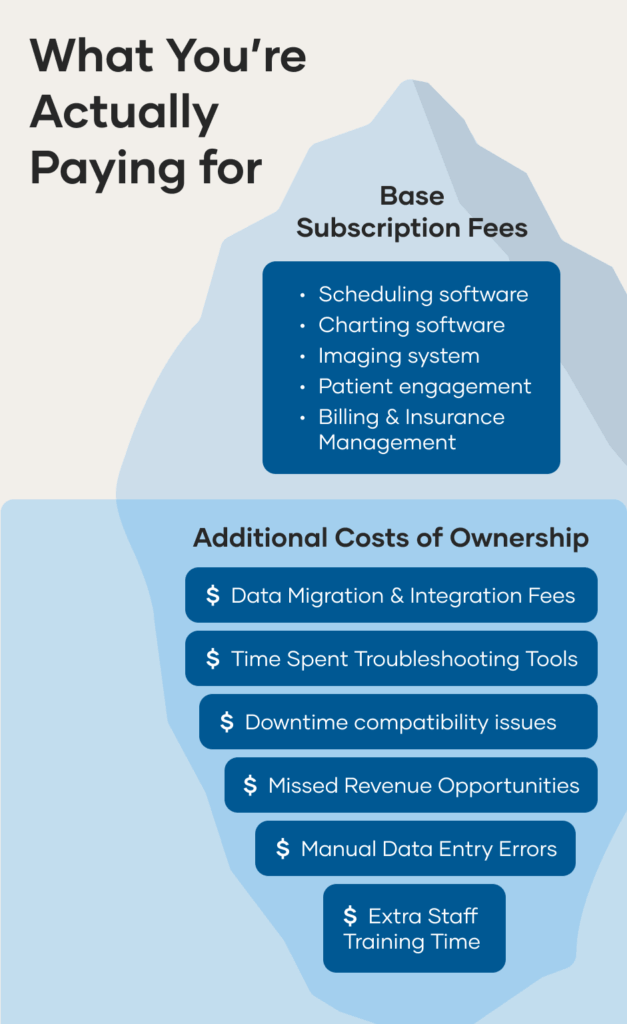
When evaluating dental software, it’s tempting to focus on the lowest monthly fee. On the surface, it feels like a smart, budget-conscious decision—especially when you’re managing a full schedule and watching every dollar.
But what often gets overlooked are the two most common traps that end up costing practices far more in the long run:
Trap #1: The Low-Cost Software That Can’t Keep Up
Low-cost dental software might check the basic boxes—scheduling, charting, maybe billing—but the tradeoffs are rarely worth the small monthly savings.
What looks like value quickly turns into daily inefficiencies: slow performance, clunky interfaces, disconnected tools, and frustrated staff. Even worse, bargain software often can’t scale with your practice, leaving you boxed in when you’re ready to grow or adopt new technology.
Here are seven hidden costs that often come with outdated or underpowered software:
Poor Integrations Hidden Cost: Manual workarounds and double entry between systems that don’t communicate. Impact: Wasted time and higher risk of errors.
Limited Functionality Hidden Cost: Paying for third-party add-ons just to access common features. Impact: Costs creep up and the platform becomes harder to manage.
Clunky User Experience Hidden Cost: More time spent training and troubleshooting. Impact: Lower team morale, slower workflows, and more mistakes.
Unreliable Reporting Hidden Cost: No visibility into key performance metrics. Impact: Poor decisions and missed growth opportunities.
Weak Customer Support Hidden Cost: Lost productivity during tech issues. Impact: Downtime, delays, and stressed-out staff.
Security and Compliance Risks Hidden Cost: Poor data protection and potential PIPEDA violations. Impact: Legal exposure and loss of patient trust.
Switching Costs Hidden Cost: Eventually needing to replace the system entirely. Impact: Migration, retraining, and operational disruption.
Trap #2: Stitching Together a “Complete” Solution
The second trap is more subtle—but often even more expensive over time: choosing a basic software platform and then layering on third-party tools to try and build a “complete” solution.
At first, this piecemeal approach may feel flexible or cost-effective. But it rarely stays that way.
Every additional tool adds another contract, another login, another support number, and another way for something to break. And because these solutions weren’t built to work together, they often don’t—leading to disconnected data, repetitive manual entry, and an increasingly complex workflow.
Each tool addresses a need—but collectively, they introduce friction, duplication, and hidden costs. You’re left managing multiple bills, multiple vendors, and a team that’s constantly switching contexts just to do their jobs.
And here’s the kicker…
What seems “cheaper” on paper often ends up costing more than an all-in-one system like ClearDent—especially once you factor in:
Add-on subscription fees
Integration workarounds
Support overhead
Staff training across multiple platforms
Time lost due to inefficiencies
So while all-in-one platforms like ClearDent may carry a higher sticker price upfront, they deliver more value, fewer headaches, and lower total cost of ownership over time. With one platform, one support team, and one place for your data, everything simply works—together.
The Smarter Question to Ask
Instead of asking: “How much does this software cost?”
Start asking: “What will it cost me—in time, money, and missed opportunity—to keep using it?” and “Will this platform grow with me, or will I have to rebuild my tech stack in a year or two?”
The true cost of dental software isn’t just the monthly fee—it’s the total impact on your practice’s productivity, profitability, and potential for growth.
How All-in-One Software Helps Your Practice Scale
An all-in-one platform isn’t just about convenience—it’s about setting your practice up for sustainable, scalable growth. When your software connects the dots between clinical care, operations, and patient engagement, your team spends less time wrestling with tech and more time delivering great dentistry.
ClearDent’s fully integrated platform is built to do just that. From scheduling and imaging to patient communication, payments, and beyond, every component is designed to work seamlessly together—backed by local support, robust security, and ongoing product innovation that keeps pace with a rapidly evolving industry.
With fewer moving parts, you reduce the risk of errors, streamline your day-to-day workflows, and gain deeper insight into your practice’s performance—all from one connected system. And as new technologies like AI continue to emerge, ClearDent’s modern architecture ensures your practice is ready to evolve without disruption.
Real World Example: The Missed Opportunity Moment
You’re checking out Mrs. Jones after an Invisalign consult. The front desk sees the appointment, collects payment, and books her next visit. Without an all-in-one fully integrated system, here’s what they don’t see:
Mrs. Jones is 3 years overdue for her cleaning and x-rays (~$300)
Her two children are also overdue (~$200 x 2 = ~$400)
Her husband has a balance on file (~$100)
In a basic system, this context is missing. The team checks the patient out and moves on.
That’s over $800 in unbooked treatments and outstanding balances—left on the table.
But with ClearDent, these insights appear automatically, giving your staff the chance to act in real time. That’s not just convenience—that’s revenue. That’s proactive care. That’s trust.
It’s not just about having data. It’s about using that data at the right moment to make the right decisions. That’s what ClearDent’s all-in-one platform enables.
Real World Opportunity: Leaving Money on the Table Every Day
It’s 10:17 PM on a Tuesday. A new patient visits your website looking to book an appointment. But your office is closed, your phones are off, and your third-party booking tool isn’t connected in real time. So what happens?
They bounce.
They find another practice with online booking that’s fast, easy, and available 24/7.
That’s not just a missed click—it’s a missed patient. A missed treatment plan. A missed opportunity.
With ClearDent’s fully integrated Online Booking tool, your practice is always open. It connects directly to your schedule, eliminating double-booking, delays, and missed chances to fill your chair.
And here’s what that looks like in practice:
190+ new patients per year
$50,000+ in additional net revenue
90+ staff hours saved annually from fewer calls and manual scheduling
Without a truly integrated booking tool, not only do you make it harder for existing patients to schedule appointments, but you’re closing the door on new business every night—and you may not even realize it.
ClearDent doesn’t just help you run your day. It helps you capture the opportunities happening when you’re not even looking.
Final Thoughts
Choosing dental software is one of the most important business decisions a practice can make. It impacts your team’s efficiency, your patient experience, and your ability to grow. While low-cost or piecemeal solutions may seem appealing at first glance, they often create more problems than they solve.
An all-in-one platform like ClearDent delivers more than just software—it delivers clarity, control, and confidence in your practice’s future. When everything works together, everything works better.
Ready to explore a truly integrated solution? Book a demo with ClearDent and see how all-in-one software can support your next stage of growth.
It’s a packed schedule, as usual.
Your 10 a.m. patient is in for a hygiene appointment. The hygienist notes signs of teeth grinding, but doesn’t bring it up—there’s no set process. The dentist is running slightly behind and moves on to the next patient without discussing a night guard.
At 11:30, a patient mentions they’ve been self-conscious about their smile. You recall they once asked about teeth whitening a year ago, but that note is buried somewhere in their chart. You think about offering clear aligners—they’d be a great candidate—but the appointment is running long and there’s no time to dive into it.
By the time 4 p.m. rolls around, your team is just trying to stay afloat. Patients are getting solid care, but meaningful treatment conversations are slipping through the cracks. They leave with clean teeth and a quick thank-you—but without knowing they had real options to improve their oral health.
Multiply this across the week, and the lost opportunity becomes clear—not just in revenue, but in care.
Walking the Tightrope Between Missed Care and Overselling
Missed Opportunities to Introduce Additional Services
Many dental practices are hesitant to mention elective or complementary treatments unless absolutely necessary. No one wants to feel like they’re “selling”—but that often means patients don’t hear about services that could actually benefit them.
Overselling Damages Trust
On the other end of the spectrum, some practices go too far. Constantly pushing cosmetic upgrades or unnecessary add-ons can feel more like a “used car” sales pitch than patient care. And in today’s economy, where patients are more cost-conscious than ever, that approach doesn’t just lead to a “no”—it leads to lost trust and, potentially, lost patients.
No Visibility iInto What Drives Revenue
Without clear reporting on which dental procedures are driving profit and being consistently accepted, practices operate in the dark. This makes it hard to prioritize staff training, marketing, or even which services to proactively highlight.
Financial Barriers Block Patient Decisions
Even when patients are interested, high-cost dental treatments can feel out of reach—especially when there’s no payment flexibility built into the conversation.
Staff Struggle to Confidently Present Treatment Options
If your team isn’t equipped with the right tools—or the right language—patients may misunderstand or assume they’re being upsold, rather than genuinely cared for. Communication skills matter just as much as clinical knowledge. When staff are trained to approach conversations with empathy and curiosity, they can better understand a patient’s concerns, priorities, and financial sensitivities. It becomes less about recommending a procedure and more about guiding the patient toward informed choices they’re comfortable with.
These challenges make it difficult for practices to maximize revenue in an authentic and sustainable way—without compromising patient trust.
Confidence, Clarity, and Care-First Planning
Proactive Treatment Planning
With ClearDent, elective treatments can be flagged and bundled into larger care plans that make sense for the patient. Whether it’s grouping preventive care with cosmetic options or surfacing prior treatment notes, your team is equipped to present relevant options naturally.
Insights That Drive Smarter Decisions
ClearDent’s production reports give practices a clear view into what’s working—from the procedures that bring in the most revenue to those with the highest acceptance rates. For example, if the data shows your whitening treatments are consistently accepted and drive strong revenue, it might be time to feature them more prominently in patient communications—or make them part of a bundled care offer. That way, you’re not guessing where to focus; you’re investing in what’s already proving effective. These insights help your practice promote services that align with patient interest and profitability—allowing you to maximize revenue with confidence.
Payment Plans Built In
ClearDent’s Contract Billing tool allows practices to offer structured, easy-to-manage payment plans. This removes the “I can’t afford it right now” barrier and lets patients say yes to the care they want—without financial strain.
Visual Tools That Build Trust
Digital imaging and visual treatment planning features give staff the confidence to explain procedures clearly. When patients can see what’s going on and understand why care is being recommended, …it no longer feels like a pitch—it feels like a partnership that ultimately helps you maximize revenue through trust and transparency.
The Pain-Free Practice
Imagine a dental practice where treatment conversations are thoughtful, timely, and rooted in patient care.
A patient comes in for their routine cleaning. While reviewing their chart, the hygienist is prompted by ClearDent to ask if they’re still interested in teeth whitening. They smile and say, “Actually, yes—I just didn’t want to bring it up if it wasn’t the right time.” It’s added to their treatment plan, and they’re excited.
In another operatory, a staff member walks a patient through their visual chart, showing clear signs of wear on their molars. They explain the benefits of a night guard—not as an upsell, but as a preventive measure to protect their teeth. The patient agrees, understanding it’s in their best interest.
Another patient expresses interest in orthodontic options but hesitates at the cost. The team offers a monthly payment plan through ClearDent’s Contract Billing tool, making it doable without stress.
In each case, care is personalized, options are presented with confidence, and trust is maintained.The practice is thriving—not because it’s pushing unnecessary treatments, but because it’s delivering better care—and naturally maximizing revenue per patient as a result.
Conclusion – It’s Not About Selling More. It’s About Caring Better
Maximizing revenue per patient isn’t about pushing treatments patients don’t need. It’s about creating a system that supports meaningful care conversations, improves access to treatments, and helps patients make informed choices.
With the right tools in place, your practice can walk that fine line—offering more without overselling. When you focus on relevant care and patient-centered communication, your ability to maximize revenue grows organically—without ever compromising patient relationships. And when patients feel respected, empowered, and cared for, they’re not just more likely to say yes—they’re more likely to stay.
It’s Friday afternoon, and the last patient just left. You finally have a moment to breathe. The week felt productive—your schedule was full, patients left smiling, and the team kept things moving. On the surface, everything seemed like a success.
But as you open up your monthly practice performance reports, that confident feeling fades.
Your production numbers don’t match expectations. Collections are lagging. Accounts receivable are higher than last month. You notice a few patients who completed treatment haven’t paid, and insurance claims are still pending from weeks ago.
You approach your admin team, asking for a breakdown. They pull up a single report they’ve been using for months, but it doesn’t tell the full story. Another team member says they haven’t reviewed reports in weeks—they’ve been too busy at the front desk. Nobody’s sure when the last time was that someone looked at billed vs. planned production or analyzed trends over the last quarter.
Despite working tirelessly, you’re still unsure whether your dental practice is actually growing. That’s the danger of operating without visibility—everything feels fine until it’s not.
The Practice Performance Pain Point: Operating Without Visibility
It’s easy to underestimate the impact of not reviewing your practice performance regularly.. Many dental offices It’s easy to underestimate the impact of not reviewing your practice’s financial performance regularly. Many dental offices either don’t run reports at all or focus too heavily on one or two familiar reports and use them as the sole source of truth for business decisions. But no single report can tell you everything you need to know about production, collections, and profitability.
Most teams are unaware of, or overwhelmed by the volume of financial data available. Reports are run sporadically, interpreted inconsistently, or ignored altogether. And even when they’re reviewed, it’s usually after problems arise—not before.
This creates a pattern of reactive management. If production dips, no one notices until it’s too late. If collections fall short, the issue isn’t addressed until the next billing cycle. If recall rates decline, schedules begin to open up without explanation.
Without regular check-ins and clarity around which reports matter, long-term trends go unnoticed and practices miss critical opportunities to:
Identify recurring slow seasons
Address billing bottlenecks
Spot treatment acceptance gaps
Reduce overdue accounts receivable
Balance provider productivity across the schedule
Over time, these blind spots chip away at revenue, efficiency, and growth—making it harder to make informed decisions.
How ClearDent Boosts Practice Performance
CleClearDent simplifies performance tracking by helping dental practices focus on the most impactful reports—with no more guesswork.
Clear Reporting Focus
Rather than offering dozens of disconnected reports, ClearDent highlights the key performance indicators that drive better decision-making:
Production by Provider: Understand each provider’s output and identify imbalances in your schedule or team performance.
Billed vs. Planned Production: Spot where treatments are falling through the cracks. Whether due to incomplete documentation or front desk follow-up, this report helps plug revenue leaks.
Accounts Receivable Aging: Get a real-time view of overdue balances, broken down by aging periods, so your team can act before collections become an issue.
These core reports are essential for dental practice reporting and help translate raw data into clear, actionable insights.
Customizable Business Analytics Tools
WithClearDent Cloud, you can customize your business analytics dashboard to show your most important metrics right on your homepage. From collections trends to monthly production goals, you’ll have visual data insights at a glance—no more setting time aside to run manual reports just to get a pulse on your practice.
These easy-access widgets help dental teams form the habit of reviewing financial performance regularly. It becomes part of the weekly workflow, encouraging proactive adjustments instead of reactive responses.
Integrated Ledger for Accuracy
What makes these insights even more powerful is their connection to ClearDent’s integrated ledger system. From billing and collections to insurance payments and adjustments, everything flows through a single platform.
This eliminates data silos, reduces manual errors, and ensures your reports reflect real-time financial conditions. Your team can confidently rely on the data to guide decisions and adjust strategies.
The Pain-Free Practice
Imagine this:
It’s Monday morning. Your office manager logs into ClearDent Cloud and sees your top KPIs on the homepage dashboard—production by provider, monthly collections, and A/R trendlines. These visual summaries provide a quick snapshot of the practice’s overall financial health.
Later in the day, they view the Billed vs. Planned Production and notice that the actual production is not keeping up with the planned treatment. The office wants to dive deeper. Curious, they dig into the Treatment Plan Manager and find the issue: completed procedures weren’t billed. Some treatments had been done before approval or without submitting predeterminations—resulting in missed revenue.
Then, with just a few clicks, they open the A/R Aging report and identify several patients who have overdue balances over 60 days. The team initiates a personalized follow-up sequence and prevents those accounts from slipping further into collections.
By Friday, outstanding balances are reduced, production is back on track, and the team feels confident in their decisions—all thanks to the habit of reviewing the right data at the right time.
Stop Letting Revenue Slip Through the Cracks
Dental practices aren’t just healthcare providers—they’re businesses. And like any business, you can’t manage what you don’t measure.
When you’re in the dark on practice performance, even small problems can grow if left unchecked. Missed revenue, high accounts receivable, underperforming providers, or unclear billing processes can drag down your bottom line—and your peace of mind.
ClearDent gives you the tools to take control. With integrated dental software reporting tools, business analytics dashboards, and a reliable ledger at its core, you gain full visibility into your practice’s financial performance. No more guesswork. No more outdated reports. Just the clarity you need to grow with confidence.
It’s 8:30 a.m., and the team is gearing up for a full day—at least that’s what the schedule says. But by 10 a.m., two appointments have cancelled, and an early afternoon hygiene slot is sitting unconfirmed—just a few more empty spots that are becoming all too common. The front desk scrambles to make calls, but most patients don’t answer during work hours.
Looking back, you realize this isn’t a one-off problem. Thursdays are always a little slower. Late-day cancellations happen often, and rescheduling is hit-or-miss. Despite spending money on marketing and maintaining high-quality care, the financial report at the end of the week shows another shortfall in revenue.
The frustrating part? Everyone is working hard—but the tools just aren’t in place to spot the patterns, recover from last-minute changes, or turn open time into booked production. You’re not short on patients—you’re short on insight and efficiency.
Scheduling Gaps Are a Revenue Killer
When it comes to managing your practice’s revenue, few things create as many headaches as co-payment Empty spots in the schedule aren’t just inconvenient—they’re costly. And without the right visibility into patterns or the tools to react quickly, the problem compounds. Here’s what’s often behind the gaps:
No Visibility = No Strategy Most practices don’t track scheduling trends in a way that helps them understand patterns. As a result, low-traffic periods go unaddressed, and staff are stuck reacting rather than planning.
Unfilled Chairs = Lost Income One hygiene appointment per day may not seem like much—but multiply that across a month, and its thousands in lost production.
Cancellations Caused by Financial Stress Especially in today’s economy, patients may cancel or delay appointments due to cost. If your practice doesn’t offer flexible options,like payment plans, automated contract billing, or clear insurance breakdowns, those visits are simply missed opportunities.
Manual Recalls = Missed Hygiene Revenue Hygiene recalls are a major revenue stream—but if your team is manually managing follow-ups, it’s easy for patients to fall through the cracks.
No Real-Time Tools = Missed Rebooking Opportunities When a last-minute cancellation happens, there’s often no efficient way to get the word out to patients who’d happily take the slot. That open time stays open—and revenue never walks through the door.
The ClearDent Pain Killer
ClearDent provides the tools practices need to protect revenue and take control of their schedule.
Use Reporting to Identify and Prevent Low-Traffic Periods
With ClearDent’s customizable reporting, you can analyze appointment trends by day, week, provider, or treatment type. Commonly used reports include the Production by Provider report to monitor booking gaps, the Daily and Weekly Production Summary to identify underperforming time slots, and the Appointment Report to review no-shows and cancellations. These reports provide the insight needed to anticipate dips and proactively shift staffing or scheduling strategies to make better use of available time.
Turn Cancellations into Revenue Opportunities
ClearConnect’s real-time text and email reminders make it easier to notify patients when an opening becomes available—saving staff from making multiple manual calls.
Online Booking also allows patients to see and book available appointments at their convenience, including outside regular office hours, helping to fill empty spots more efficiently.
Offer Payment Plans That Encourage Treatment Follow-Through
With ClearDent’s Contract Billing, patients can access flexible, manageable payment options. This makes it easier for them to move forward with care—so they don’t cancel or delay due to financial concerns. For the practice, it means fewer no-shows and a more consistent schedule.
Automate Recalls to Keep the Hygiene Schedule Full
ClearDent’s Recall Manager, paired with ClearConnect’s automated outreach, identifies overdue patients and follows up with personalized messages—no manual work required. You’re not just reminding patients—you’re building a system that keeps your chairs filled and your hygiene revenue steady.
The Pain-Free Practice
Imagine this:
It’s a rainy Monday morning and a last-minute cancellation comes through. But instead of losing production, the front desk quickly pulls up a list of patients who are due for care or have previously asked about earlier appointments. They send a quick text or email with a link to the practice’s online booking page, letting those patients know there’s an opening. Within 20 minutes, a patient books the slot—saving the front desk from making multiple phone calls and keeping the day on track.
Later that week, a scheduling report shows that Wednesdays are consistently underbooked. Not only can you adjust provider hours slightly, but you can make sure those appointment slots are available for online booking and use ClearDent’s bulk messaging tools to offer earlier appointments to hygiene patients with upcoming recalls.
At the end of the month, you run your production and revenue reports—no surprises. You’ve met your goals, the schedule feels stable, and you’ve filled more empty spotsthan ever before by staying proactive. Instead, they’re focused on patient care and revenue is on track.
Stop Letting Revenue Slip Through the Cracks
Your dental schedule is more than a calendar—it’s a key driver of revenue and operational success. Every open slot represents income left on the table. Over time, those gaps quietly erode profitability.
By using ClearDent’s tools to analyze scheduling trends, fill cancellations faster, offer flexible payment options, and automate recall management, practices can regain control and boost financial performance.
Don’t let avoidable inefficiencies hold your practice back. Start managing your schedule with revenue in mind—and take the first step toward a more productive and profitable practice.
It’s late afternoon and your front desk is trying to close out the day. One patient is wrapping up a filling and heading out the door. Insurance coverage for the procedure is unclear, and the admin team doesn’t want to risk misquoting, so they say, “We’ll email you the statement later.” An email goes out that evening—but no payment comes in.
A few weeks pass. Still no response. The email was sent, but there’s been no follow-up—and no payment.
Meanwhile, another patient is sitting in the chair, recommended for a crown. But the treatment plan estimate is vague. When they ask how much they’ll owe out-of-pocket, your staff stumbles through a confusing explanation. The patient decides to “think about it” and never books.
A third patient is already on a payment plan—but it’s tracked in a spreadsheet, and someone forgot to send the next reminder. That balance is now overdue, too.
Staff are juggling too many tasks, spending hours manually tracking outstanding balances and sending reminders—when they remember. But despite their effort, accounts receivable (A/R) is creeping up. The team is doing their best, but without the right tools, payments keep slipping through the cracks.
Co-Payment Management Challenges Drive Up A/R
When it comes to managing your practice’s revenue, few things create as many headaches as co-payment collection. Co-payments are often one of the most misunderstood, miscommunicated, and poorly tracked parts of the billing process—and when they’re not handled well, it directly contributes to ballooning accounts receivable (A/R), inconsistent cash flow, and frustrated staff:
Patients don’t always pay the full amount at the time of service. While some practices enforce upfront payments, insurance uncertainty often forces teams to charge a fixed or estimated amount. Without confirmation from the insurer, the practice must either manage reimbursements later or carry a credit balance on the account—something patients aren’t always comfortable with. This leads to follow-up, confusion, and delays in payment collection.
Staff struggle to explain co-payments. Insurance coverage is complicated, and without integrated estimates, staff lack the confidence and clarity to clearly communicate patient responsibility.
No easy way to collect off-site. Practices often wait for patients to return—if they do.
Manual tracking of outstanding balances. Follow-ups and reminders are often done manually, leading to inconsistency and human error.
Inconsistent follow-ups. Without automation, patients fall through the cracks, and payments get forgotten.
Poorly structured payment plans. While flexible options are helpful for patients, they’re difficult to manage without a structured, automated system.
Lack of visibility into A/R trends. Without real-time reporting, practices don’t know where they stand until it’s too late.
These issues don’t just create a little extra work—they lead to high A/R, unpredictable cash flow, and burned-out staff.
The ClearDent Pain Killer
Solving co-payment challenges doesn’t have to mean more work for your team—it just means having the right system in place. ClearDent’s platform is built with these financial pain points in mind, offering a suite of integrated tools that help you simplify collections, reduce administrative workload, and ensure patients understand and fulfill their financial responsibility. From real-time billing clarity to automated payment tracking, ClearDent turns one of the most frustrating parts of practice management into one of the easiest:
EOB Auto Adjust: Automatically applies insurance adjustments to the patient ledger based on the Explanation of Benefits, so staff can confidently collect the correct amount at the time of service.
Integrated Treatment Planning & Estimates: Staff can clearly show patients what insurance covers and what they’ll owe out-of-pocket—boosting trust and treatment acceptance.
Automated Payment Reminders & A/R Tracking: Keep follow-ups consistent and timely without adding more to your team’s plate.
Contract Billing (Payment Plans): Create structured, recurring payment plans that are tracked and managed automatically within the system.
A/R Reports & Dashboards: Get a clear picture of your financials, track overdue accounts, and identify opportunities to improve collections.
With ClearDent, collecting payments isn’t just easier—it’s built into the workflow.
The Pain-Free Practice
Imagine your front desk team closing out the day without stress, knowing that co-payments have been explained clearly and collected in real time.
Imagine knowing exactly how much is outstanding, what’s trending, and where your revenue is going.
That’s what happens when your co-payment management tools work with you, not against you.
Stronger Tools. Smarter Payments. Lower A/R.
High A/R isn’t just a numbers issue—it’s a sign of system inefficiencies that burden your staff and disrupt your cash flow. With the right technology in place, collecting co-payments can be simple, consistent, and built into every step of the patient journey.
ClearDent helps you get paid faster, reduce administrative burden, and empower your team to work smarter—not harder. From automated reminders to accurate EOB adjustments—every feature is designed to eliminate the friction in getting paid.
Because when payment is easy, A/R doesn’t stand a chance.
You’re running a busy, thriving practice. Chairs are full. Patients are happy. Your team is firing on all cylinders to deliver great care and keep the schedule moving. But when it’s time to review your financials, something doesn’t add up—your ledger write-offs are climbing, and it’s not clear why.
Collections are lower than expected. Accounts receivable is climbing. Write-offs are becoming more common. The hard work is there—but the revenue isn’t keeping pace.
You start digging into the ledger and realize your staff is spending hours every week manually adjusting insurance claims, navigating unclear patient balances, and reconciling accounts long after the visit has ended. Little issues have quietly snowballed: a missed co-pay here, a miscalculated adjustment there. Without easy ways for patients to pay or clear visibility into outstanding balances, payments are delayed or missed entirely.
The reality is the ledger write-offs aren’t the result of one big mistake. They’re the result of dozens of small inefficiencies that slowly erode your bottom line.
Mistakes That Cost You Money
High ledger write-offs don’t happen all at once. They’re the byproduct of an inefficient financial workflow—one that puts too much pressure on your staff to get things right without giving them the right tools.
Let’s break down the most common contributors:
1. Inaccurate Data Entry
Manually entering insurance adjustments or patient balances creates opportunities for errors. It’s easy to mistype an amount, apply a payment to the wrong visit, or miss an adjustment altogether. These small errors often lead to balances that can’t be collected.
2. Insurance Adjustment Confusion
Your staff is often expected to calculate what the patient owes after insurance—sometimes on the spot. While some insurance providers offer pre-approved estimates, not all do. In many cases, staff have to check in advance, ask patients to wait, or follow up after the appointment to confirm the exact amount. Without built-in tools to guide those calculations, they’re left estimating based on carrier rules or past experience, which introduces room for error and missed revenue.
3. Delayed Reconciliation
If you’re only reconciling financials monthly (or even less often), you’re likely missing discrepancies that could be fixed earlier. The longer they go unnoticed, the harder they are to correct—and the more likely they are to result in a write-off. In many cases, practices want to run more frequent reports, but their current software makes it too time-consuming or difficult to generate daily or weekly insights. As a result, they stick with what’s easiest—even if it means spotting issues too late.
4. Lack of Visibility into Patterns
Without clear reporting, it’s hard to see what’s causing write-offs. Is it a particular insurance provider? A training issue? A process bottleneck? Without visibility, the cycle continues.
Turn the Ledger Into Your Financial Lifeline
ClearDent’s ledger is more than just a place to record payments—it’s a system designed to reduce ledger write-offs and improve accuracy. It’s designed to help practices proactively manage revenue and reduce the risk of write-offs through automation, clarity, and accountability.
EOB Auto-Adjust: ClearDent automatically applies insurance adjustments based on the EOB. This removes the need for manual entry, reducing errors and freeing up staff time.
Automated Billing & Ledger Adjustments: ClearDent calculates what the patient owes and applies it to the ledger in real time. Your staff no longer has to rely on guesswork or mental math.
Real-Time Reporting & Ledger Tracking: Financial reporting in ClearDent is customizable to your workflow. Whether you review daily, weekly, or monthly, you can track financial discrepancies, monitor A/R, and spot issues early.
Audit Trails & Reporting Tools: Every transaction is traceable. If write-offs occur, you can see where they originated and address the root cause—whether it’s a training opportunity, workflow change, or system update.
What Life Looks Like with the Right Ledger
Imagine this:
You sit down to review your financials at the end of the month. There are no surprises. Write-offs are minimal and predictable. Your staff is confident because they trust the system. Insurance adjustments are handled automatically. Patients are paying on time because it’s easy.
And when issues do arise, you have ClearDent tools like Real-Time Reporting, Audit Trails, and EOB Auto-Adjust to identify the root cause and take action—quickly and confidently. Real-Time Reporting helps you monitor financial trends on your schedule, Audit Trails show you exactly where issues originate, and EOB Auto-Adjust ensures your insurance adjustments are accurate from the start.
With ClearDent, your ledger becomes a powerful tool for protecting your revenue, supporting your team, and keeping ledger write-offs under control.
Conclusion
Write-offs might seem like a normal part of doing business, but they shouldn’t be. Most of the time, they’re a signal that your financial systems need more support. When you empower your team with tools that automate the complicated parts of billing, provide real-time insights, and make it easy for patients to pay, you dramatically reduce the risk of errors and missed revenue.
ClearDent’s smart ledger tools are built to simplify your financial operations, reduce stress, and increase collections. The result? A healthier bottom line, a more confident team, and more time to focus on what matters most—your patients.